Why Do Natural Stone Products Look Different from Samples
Nov 25, 2026
When ordering natural stone products, buyers often expect the finished items to look exactly like the samples they approved. However, the delivered marble, granite, or quartzite may show differences in color, veining, or pattern distribution. This is a common concern in international stone orders, especially when purchasing countertops, vanity tops, dining tables, or other customized products.
From a stone factory's perspective, these differences are mainly related to the natural characteristics of the material, slab selection, and the production process. Understanding these factors before placing an order can help buyers avoid unnecessary misunderstandings.
1. Natural Variations in Color and Veining
Unlike engineered materials, natural stone is formed through geological processes over millions of years. Each block has its own mineral composition, color distribution, and vein structure.
Even within the same quarry, two marble blocks may have noticeably different backgrounds or veining patterns. A small sample can show the general appearance of a material, but it cannot represent every detail of a full slab.
For example, white marble may contain different levels of gray veining, while some beige marble varieties can show variations in background tone and mineral markings. These differences are part of the material's natural character rather than automatically indicating a quality problem.
2. Differences Between Sample Pieces and Full Slabs
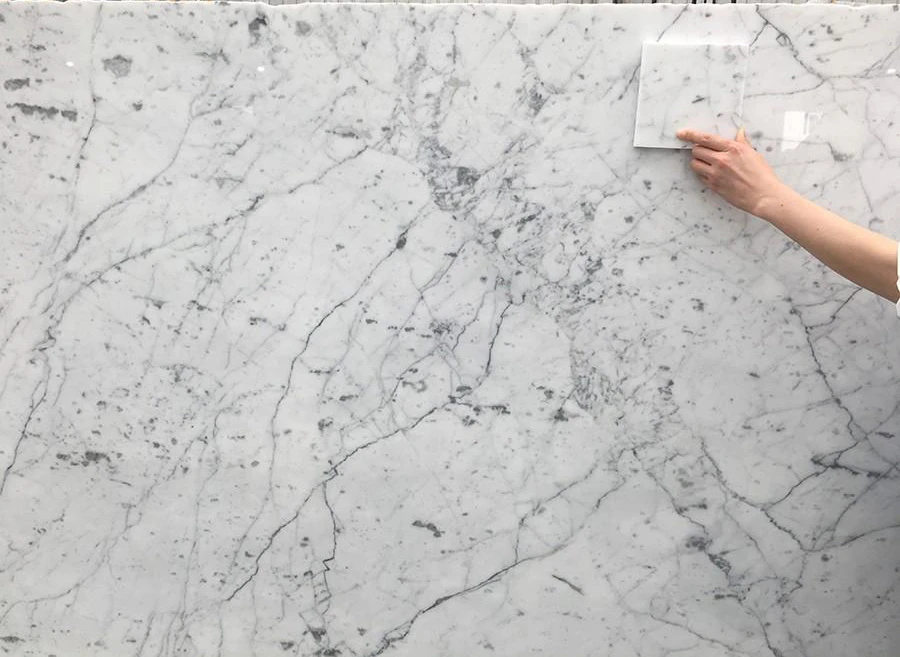
A sample is usually a small cut piece selected to demonstrate a stone's general color and texture. However, the appearance of a full slab can be quite different because natural patterns are not evenly distributed.
A small sample may show relatively uniform colors, while the full slab may contain stronger veins, mineral spots, or larger color transitions. This is particularly important when producing large countertops, dining tables, and bookmatched wall panels.
For bulk orders, buyers should not rely on a small sample alone. Reviewing actual slab photos or videos before production provides a more reliable basis for material approval.
3. How Cutting and Surface Finishing Affect Appearance
The final appearance of natural stone can also change during processing.
Different cutting directions may expose different vein patterns, especially in marble and quartzite. Polished, honed, leathered, and brushed finishes can also influence how colors and natural textures appear under light.
For customized products, the factory needs to consider the cutting layout, vein direction, and surface finish together. This is particularly important when several pieces must maintain a consistent visual appearance within the same project.
4. How Buyers Can Reduce Appearance Differences
Although natural variations cannot be completely eliminated, proper communication and material selection can reduce unexpected differences.
Before production, buyers should:
Confirm the acceptable color and veining range rather than relying on one small sample.
Request photos or videos of the actual slabs selected for the order.
Confirm the cutting direction and surface finish for customized products.
Reserve materials from the same block or batch when visual consistency is important, subject to availability.
Approve the material selection before cutting and fabrication begin.
For large projects or repeat orders, keeping approved reference photos and material records is also useful for future purchasing.
5. Natural Variation vs. Manufacturing Quality
It is important to distinguish natural stone variation from actual production defects. Changes in veining, background color, and mineral distribution may be expected, but incorrect dimensions, chipped edges, poor polishing, or damage caused during handling should be evaluated separately.
A professional stone supplier should explain the expected material range before production and carry out inspections to ensure that finished products meet the confirmed specifications.
Final Thoughts
Natural stone samples provide a reference for material selection, not a guarantee that every finished product will have an identical appearance. For importers, wholesalers, and project buyers, reviewing actual slabs and confirming acceptable material variations before production are essential steps. Clear communication between the buyer and stone factory helps reduce disputes and makes customized stone orders easier to manage.