Production and Processing Workflow for Calacatta Viola Marble Integrated Washbasins
Sep 24, 2026
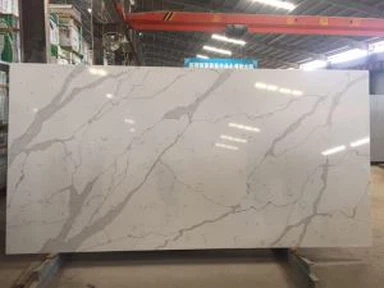
Calacatta Viola marble is visually characterized by a white background with gray and purple veining, making it highly valued for custom bathroom applications in high-end residences, hotels, private clubs, and commercial spaces. For B2B buyers, producing a calacatta viola marble sink involves more than simply cutting a block of stone into a sink; it requires comprehensive planning-starting with raw material selection-regarding veining, cutting orientation, basin shape, and machining precision.
I. Material Selection: Origin, Price, and Preferred Veining
Calacatta Viola marble used in the market mainly comes from Italy and Turkey. Although both are sold under the Calacatta Viola name, there can be noticeable differences in color, veining, surface appearance, and price. Italian Calacatta Viola is generally more expensive, while Turkish Calacatta Viola is usually more competitive in price. For this reason, the material origin should be confirmed before providing a formal quotation or starting production.
For high-end projects with a stronger focus on the stone's visual character, Italian material may be selected for its specific veining and overall appearance. When project budget is a more important consideration, Turkish Calacatta Viola can provide another sourcing option. However, the final selection should not be based on origin or price alone. The actual slab appearance, veining pattern, purple tone, required quantity, and product design should all be considered together.
When selecting materials for integrated basins, particular attention must be paid to the slab's background color, the proportion of purple veining, the direction of the veins, and the location of any cracks or imperfections. Some clients prefer a cleaner white background with minimal purple, while others explicitly request more prominent purple veining. Such preferences directly influence the subsequent cutting strategy.
If a client prefers more purple veining, one cannot focus solely on material yield. Instead, slabs with concentrated purple veining-distributed in a way that suits the basin's design-must be sourced in advance, and cutting positions planned according to the basin's dimensions. Therefore, when comparing Italian and Turkish Calacatta Viola, it is important to compare the actual slab quality and visual characteristics together with the price, rather than comparing only the price per square meter.
II. Cutting: Layout Planning Based on Basin Structure
Once the slab is selected, the layout is planned based on the integrated basin's length, width, height, thickness, and internal basin dimensions. For Calacatta Viola marble, which features distinctive veining, the cutting orientation is crucial. Cutting the same slab from different directions can result in vastly different visual effects.
During production, the relationship between the veining on the countertop surface, the basin body, and the backsplash is typically established first to ensure a natural, continuous visual flow in the finished product. For orders with specific color preferences, the client's desired veining areas must be incorporated into the layout plan from the start, rather than assessing color compliance only after production is complete.
III. Profile Machining: Establishing the Basic Basin Contour
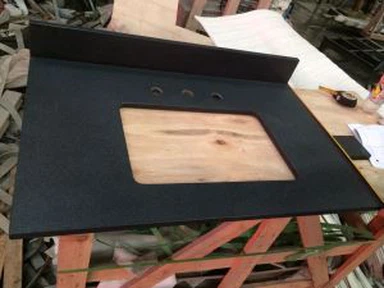
After cutting is complete, the process moves to profile machining. Based on the design blueprints for the integrated basin, the outer profile, basin bowl, rounded corners, and transition areas are machined.
During the profiling process, precise control over the basin's dimensions and the accuracy of its rounded corners is essential. This is particularly critical for integrated countertop-and-basin designs, where the thickness between the outer profile and the basin bowl must be carefully maintained; areas that are too thin could compromise structural integrity during subsequent processing or transport.
IV. Basin Bowl and Detail Processing
Once profiling is complete, the basin bowl undergoes further processing, including the shaping of the interior depth, drainage positioning, slope, and corner rounding. The bottom of the bowl must be formed with an appropriate drainage slope to ensure water flows smoothly toward the drain outlet.
Next, the edges are trimmed, beveled, and finely polished. For high-end custom orders, the uniformity of edge transitions and the smoothness of the surface finish directly impact the perceived quality of the final calacatta viola sink.
V. Polishing, Inspection, and Finishing
After machining, the product undergoes surface polishing or other treatments as specified in the order. Inspections are conducted to verify dimensions, thickness, bowl depth, drain hole placement, edge finishing, and surface quality.
For natural marbles with distinctive veining-such as Calacatta Viola marble-a comprehensive visual inspection is also required. This ensures that the proportion of purple tones, the direction of the veining, and the overall appearance align with the client's initial specifications. Finally, the product is cleaned, protected, and packaged before proceeding to export and delivery.
Summary
The true challenge in producing Calacatta Viola marble integrated basins lies not merely in profiling and polishing, but in the initial material selection phase, where the client's preferences regarding stone origin, budget, veining, and product dimensions must be harmonized.
When comparing Italian and Turkish Calacatta Viola, price is an important factor, but it should not be considered separately from the actual stone appearance. Italian Calacatta Viola is generally more expensive, while Turkish material is usually more competitive. The final decision should also consider surface aesthetics, material yield, purple veining requirements, slab availability, and the visual effect required for the finished calacatta viola marble sink.
For B2B custom orders, early confirmation of the stone origin, slab style, purple tone ratio, dimensions, and technical drawings facilitates better control over subsequent cutting and production. This proactive approach minimizes the risk of rework and material waste caused by veining patterns that do not meet expectations.